
Clay: The Slowest Overnight Success in Sales Tech
- Hans Stege
- Aug 6
- 7 min read

Updated: Aug 7
In May 2022, Clay put itself on a waitlist, pausing the onboard of new customers shortly after their product release. The company had just launched publicly on Product Hunt, revenue was close to zero, and the founders shut the door on new signups for the next 15 months while they figured out what they'd actually built. That's an unusual move for a startup five years into its life. It's an even more unusual one to make right before becoming one of the fastest-growing vertical AI names at scale in sales-focused enterprise software.
Clay was founded in 2017. It didn't cross real revenue until 2022. It hit $30 million in 2024, roughly $100 million in annualized revenue by last December, and an estimated $150 million by this May. Along the way its valuation went from $500 million to $1.25 billion to $3.1 billion to $5 billion in about 18 months. Seven years of wandering, then an 18-month sprint that, if you didn’t know any better, looks like an overnight success.

The years nobody talks about
Clay's founders, Kareem Amin and Nicolae Rusan, didn't set out to build a sales tool. Their original idea was to bring the power of programming to more people, and the product that came out of that ambition was a spreadsheet that could pull live data from the internet into any cell. It was, by Amin's own account, genuinely magical to use and had almost no fixed audience. Recruiters used it to source candidates. Engineers used it as a low-code backend. One customer mailed Amin their entire codebase and asked Clay to reverse-engineer a pipeline into NetSuite, because it was easier than building the integration themselves.
That kind of horizontal appeal looks like product-market fit from a distance. Up close, it's the opposite. Every new use case pulled the roadmap in a different direction, and Amin has described spiraling for years between outbound sales, inbound enrichment, and recruiting before the team finally committed to one customer: growth and revenue operations teams doing outbound. That commitment happened in January 2022, five years after founding. Even after committing, the team kept catching itself sliding back toward the old habit of saying yes to any interesting customer, a pattern Amin has called "the spiral." What finally broke it was a rule: once a feature was in the sprint, nothing shifted it, no matter how good the next idea sounded on a Tuesday afternoon. That kind of discipline helped solidify their product-market-fit while inflecting the growth curve.
An integration-first bet on a fragmented category
Sales tech is dominated by Salesforce and HubSpot, yet the average go-to-market team still runs somewhere around ten separate tools to close deals. If you talk to its users, it's clear that Salesforce's moat was never its interface. Instead, it has remained core due to integrations and the partner ecosystem built on top of them, which made switching away structurally painful even for buyers who disliked the product day to day. Mid-market and enterprise revenue teams, in particular, have shown they'll tolerate a clunky rep experience in exchange for that flexibility, because the real buyer isn't the seller typing into the tool. It's RevOps, and RevOps cares more about what a platform can eventually do than how pleasant it is to use today.
Clay is making the same bet at the data layer. Its waterfall enrichment engine sequences through more than 150 data providers to find a contact's phone number, title, or funding history, so a single Clay query can succeed where any one vendor alone would fail. Its AI research agent, dubbed a Claygent, goes further, answering custom questions like whether a company is SOC 2 certified or hiring for a specific role. Claygent alone passed a billion cumulative runs by last June. Intercom used it to discover that companies mentioning “fertility” on their websites tend to need better customer support tooling, a signal no traditional data provider would have known to sell. Anthropic doubled its enrichment coverage using the same waterfall approach, and Rippling's growth team used Clay's flexibility to double its year-over-year cold email performance without adding headcount.
Underneath the enrichment layer sits a genuinely different business model. Clay monetizes through a credit system rather than flat seat licenses, and this past March it split that system into two meters: Data Credits for third-party enrichment and AI costs, and Actions for the workflow steps themselves, things like CRM syncs, sequencer sends, and HTTP calls. That structure lets Clay charge for the orchestration layer separately from the data underneath it, which is a more sophisticated pricing model than either ZoomInfo or Apollo.io run today. ZoomInfo, still the category's public incumbent at roughly $300 million in quarterly revenue, is fundamentally a contact directory bolting on automation after the fact. Apollo.io has followed a similar path from its own database outward. Clay built the workflow layer first and backed into the data problem, which is why its tools compose in ways a database-first competitor's don't.
Three futures for the sales rep, and how Clay can win in any of them
In an insightful write-up following their Series C lead announcement, CapitalG lays out three plausible paths for the future of the sales rep in an AI era. In the first, AI colleagues simply replace sellers outright, and outbound becomes fully automated, with pricing compressed the way any commoditized software eventually compresses. In the second, sellers stay in the loop but get augmented by copilots that handle research, prep, and follow-up, freeing humans for the conversations that actually require a human. In the third, growth gets centralized into AI-powered control panels run by increasingly technical ops teams, while individual reps handle only the interactions that need a personal touch.
It may not matter much which of the three wins, because Clay is positioned as the tooling layer underneath all three. If sellers get replaced, Clay is the platform agents run on. If sellers get augmented, Clay is the copilot's data and workflow backbone. If growth gets centralized, Clay is the control panel. That's a rare property in enterprise software, where most vendors are betting on a specific version of the future and get punished if the market picks a different one.
What could go wrong
None of this makes Clay bulletproof. The product has a real and widely repeated criticism: it's powerful but can be hard to learn, which is exactly why a cottage industry of implementation agencies exists around it in the first place. That's a feature for community-led growth and a risk for enterprise sales cycles, since a steep learning curve is the easiest thing for a simpler competitor to attack in a pitch. Apollo.io already runs marketing built around exactly that contrast.
There's also the ordinary risk of a hot category attracting sharp, well-capitalized copycats; several venture-backed startups are chasing individual pieces of what Clay does, from AI sales agents to narrower enrichment tools, and any one of them unbundling a piece of Clay's workflow at a lower price could chip at the edges even if none of them can match the full integration depth. And a credit-based, usage-metered pricing model, however elegant, is also more complex to explain to a CFO than a flat per-seat license, which can slow enterprise procurement even when the champion inside the account is already sold.
How to grow from here
Three things stand out to further differentiate the growth story for Clay. First, the moat looks to be compounding. Every enrichment query that fails on one provider and succeeds on the next teaches Clay's waterfall which sources are actually reliable for which data types, and every one of Claygent's billion-plus runs sharpens an agent that a competitor starting today has no way to backfill. Second, the distribution is structurally cheaper than anyone else's in the category. A community that grew organically from 200 people to 11,000, plus more than 100 Claygencies who make their living implementing the product, function like a sales force Clay doesn't pay for and competitors can't hire away, because it exists inside Clay's own Slack. Third, the market Clay is selling into is still getting bigger under its feet. What started as an enrichment tool is becoming the orchestration layer for a genuinely new job category, GTM engineering, that collapses SDR, AE, and sales engineer into one function built around workflows instead of headcount. If that title sticks the way “RevOps” eventually did, Clay isn't selling into today's sales stack. It's selling the tooling for tomorrow's org chart, and it will have owned the category before most incumbents notice it exists. We're seeing that in the spend panel numbers, with an impressive and steady increase in both breadth and depth of adoption.
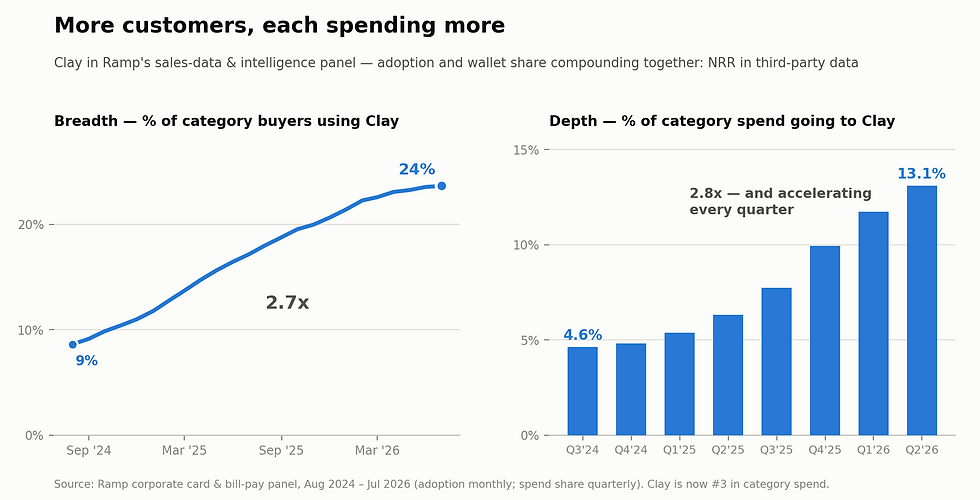
Put together, that's a company whose price has caught up with its fundamentals rather than run away from them, whose moat gets harder to replicate the longer it compounds, and whose addressable market is being redefined in its favor by the same AI wave that's supposed to be the risk. That combination is rare enough to make Clay one of the more interesting growth-stage names in the sales AI vertical.
Care to get more insights and access to our research? Fill out the form below.
RESEARCH DISCLOSURE This article is for informational and educational purposes only. It represents independent thematic analysis prepared by PrePublic Equity Partners ("PEP") and is intended to discuss industry trends and company dynamics in the private markets. This content does not constitute investment advice, a recommendation, or a solicitation to buy or sell any security or investment product. PEP is not a registered investment adviser or broker-dealer. Any offer or solicitation relating to securities will be made only through definitive offering documents to eligible investors. PEP and its affiliates may hold financial interests in companies discussed herein and reserve the right to trade such positions at any time without notice. Private market investing involves significant risk, including illiquidity and potential loss of principal. All data is sourced from publicly available information and has not been independently verified.
IMPORTANT DISCLOSURE This content is published by PrePublic Equity Partners ("PEP") for informational and educational purposes only. It does not constitute an offer to sell, or solicitation of an offer to buy, any security. No such offer or solicitation is made except by means of a confidential Private Placement Memorandum or other definitive offering documents delivered to eligible investors only. PEP is not a registered investment adviser with the SEC or any state securities regulator. Nothing in this article should be construed as personalized investment, financial, legal, or tax advice. All views are the opinions of the author as of the date of publication and are subject to change without notice. Private market and pre-IPO investing involves a high degree of risk, including illiquidity, potential total loss of principal, and reliance on unverified private company data. Past analytical observations are not indicative of future results. PEP and its affiliates, officers, or employees may hold financial interests in companies discussed in this article. PEP reserves the right to buy or sell such positions at any time without notice. PEP does not receive compensation from issuers mentioned in its research. PEP is an independently operated subsidiary of Alumni Ventures, LLC.


Comments